


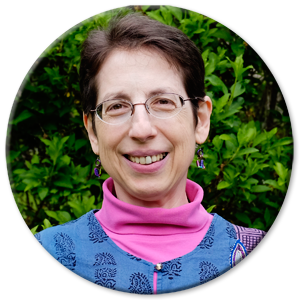
Ph.D. in Counseling Psychology
Pronouns: She/Her/Hers
Positionality: I identify as a monogamous, bisexual, cis woman. Because I am married to a man, I am taken for heterosexual and granted heterosexual privilege. Ethnically and racially, because my ancestors were all Ashkenazi European Jews, I am taken for white and given white privilege. Religiously, I am Jewish but decidedly not Zionist.
Philosophy and Values
Social justice lies at the heart of who I am and the work that I do.
I’m an intersectional feminist committed to social justice and advocacy, because I want to contribute to ending the racism, sexism, and additional social inequalities and power imbalances that permeate every aspect of our society. I believe that violence and injustice are primary causes of emotional distress, and much emotional distress will be eliminated when we successfully revamp our culture by dismantling punitive systems and becoming just and peaceful. I can’t make that happen by myself, but meanwhile, I have skills at helping people alleviate as much of their distress as possible—to live their best lives—in the context of the culture we have.
My Story
In Judaism, there is a concept of the Messianic Age, that time in human history when the world will be at peace, and harmony and justice will prevail. Tradition holds that this age will be created by the work of human beings. I was taught that I have an ethical responsibility as a Jew to be involved in tikkun olam (repair of the world). Even as a small child, I can remember feeling great sorrow over injustice and wanting to help fix it. In junior high school, I began to notice that girls and boys weren’t given the same opportunities. I railed against that injustice and identified as a feminist as soon as I learned the term in high school.I chose a profession – counseling psychology – in which I could contribute toward repair of the world. In contrast to clinical psychology, which emphasizes labeling and treating mental illness, counseling psychology emphasizes wellness, multicultural competence, strengths-based approaches, and developmental challenges such as life stressors, relationship issues, and career concerns. In practice, these two disciplines are more similar than different, but I am happy to have gotten professional training as a counseling psychologist.
My Judaism has evolved over decades. I was raised in an observant Reform Jewish home to believe that Israel was “a land without people for a people without a land.” As an adult, I learned that Israel was in fact not empty of people, but rather full of Palestinians, many of whom were killed or displaced when Israel was established, and that the remaining indigenous Palestinians were, and still are, harshly oppressed. I left Judaism for a couple of decades when I realized that my criticism of the state of Israel made me feel unwelcome in Jewish communities which blindly supported Israel. I only returned to Judaism in the early 2010s, when I discovered that Ithaca has a Jewish congregation (Tikkun V’Or) that welcomes people with a broad range of attitudes toward Israel. I currently identify most closely with The Jewish Diaspora Movement, which embraces life-affirming, vibrant, diverse expressions of Jewishness and a commitment to all people’s liberation, and which rejects the assumption that Jews need an insular culture or a militarized ethnostate.
My Approach to Therapy
As a counseling psychologist, I see you as another person like me with struggles and challenges, and I can guide you because I’ve learned skills—not because I’m perfect and have no problems. I use the terms “counseling” and “psychotherapy” interchangeably, as well as the terms “counselor” and “psychotherapist.” I’m committed to professional practice that is strength-based, culturally responsive, and socially just.I take an active role in sessions and use a variety of techniques in therapy, trying to find what will work best for you. Some of the specific techniques I use include empathic active listening, validation and normalization, cognitive reappraisal, critical consciousness-raising, psychoeducation (teaching you psychological concepts and skills), role-playing, behavioral activation, systematic desensitization, communication skills development, bibliotherapy, values clarification, career exploration, relaxation, meditation, and guided visualization.
During our online sessions, you will often see me walking on a treadmill. I find that walking keeps me engaged and focused on the conversation, and it helps me stay active, which is important to mental health. If you’d like to join me in a virtual walk, you’re more than welcome to walk on a treadmill in your space as well! And if you find it disconcerting to see me moving slightly side to side while I walk, for your sessions I’ll be happy to sit or stand instead.
How I think about and practice counseling is mainly cognitive-behavioral, but also draws from a variety of other approaches.
- Cognitive-behavioral therapy (CBT) is about how our thoughts, behaviors, physical reactions, environment, and moods are all interconnected. In CBT you learn how to change your thoughts and behaviors in order to feel better, even when the situation does not change. You also learn that, although you don’t have complete control over the situations you are in, you may have more influence over them than you realize. Here’s a 4 ½ minute video that explains CBT by Dr. Judith Beck, the director of the Beck Institute for Cognitive Behavior Therapy: https://www.youtube.com/watch?v=IlmaA5nToYM. Here’s a brief animation explaining it for youth: https://www.youtube.com/watch?v=Jz55Uk9EH6U. Here’s a brief animation explaining it for adults: https://www.youtube.com/watch?v=vpeLcMdmKek.
- Nonviolent communication, also called compassionate communication, is a philosophy that everyone’s feelings and needs matter, and an approach to communication that blends assertive self-expression with empathic listening. This 34-minute video by Dr. Roxy Manning provides an excellent introduction to NVC: https://roxannemanning.com/an-introduction-to-nvc/. For a briefer introduction, this four-minute animation “How to create win-win situations using NVC” is also excellent: https://www.youtube.com/watch?v=V-UIj01jZBE.
- Motivational interviewing is a way of talking about making healthy changes, and it is based on the premise that the best way to influence another person’s behavior is by respecting their autonomy and creating space for them to explore their own ambivalence and (hopefully) motivation for change. Here’s a brief article about it: https://www.psychologytoday.com/us/therapy-types/motivational-interviewing. And here’s a five-minute video explaining it: https://www.youtube.com/watch?v=N51jGGF7rTo.
- The Gottman Method for couples/relationship therapy draws from research on what makes relationship partners “masters” or “disasters” in relationships, and involves learning the techniques used by folks in successful relationships. Here’s a 1-minute animated video called “What is Gottman Method Couples Therapy?”: https://www.youtube.com/watch?v=A63bVVDKhTE. Here’s a 7-minute animation of the seven principles for making marriage work, as Dr. John Gottman explained in his book of the same name: https://www.youtube.com/watch?v=knBJGNisJS0&t=15s. There are also loads of videos with Drs. John and Julie Gottman, including this 17-minute video of their 2024 TED talk “Even Healthy Couples Fight – the Difference is How” (https://www.youtube.com/watch?v=nBN9zG1JNPg), this 28-minute video of Dr. John Gottman’s TEDx talk “The Science of Love” (https://www.youtube.com/watch?v=-uazFBCDvVw), and this 17-minute TED podcast “How to Be a Better Human” in which the host interviews both Drs. Gottman (https://www.youtube.com/watch?v=nJ4RtT0T_BA&t=637s).
- Intersectional Feminist Therapy (IFT) focuses on empowering women and all people who are “othered” and oppressed by mainstream culture, and on transforming oppressive societal structures. It also helps men (and all people granted privileged status by mainstream culture) to break painful patterns such as entitlement and shame, and guides them toward deeper emotional awareness and relationships grounded in truth, respect, and connection. A priority in IFT is on changing both harmful external situations and their internalized effects, rather than on helping clients adapt to dysfunctional environments. In IFT, clients develop a healthy sense of personal and social power, and sometimes choose to get involved in social movements to restructure institutions to rid them of discriminatory practices. Here’s an article about it: https://www.psychologytoday.com/us/therapy-types/feminist-therapy. Here’s Dr. Laura S. Brown’s description of it: https://www.drlaurabrown.com/feminist-therapy/. And here’s a brief (less than two minutes) video about it: https://www.youtube.com/watch?v=JKwMVdczBxs.
My Qualifications
I’m a licensed psychologist in the State of New York (license # 015622) with a Ph.D. in Counseling Psychology.George and I established our independent practice in 2015. Previous to that, I gained a broad range of clinical experience with adults and older adolescents in private practice, college counseling, community mental health, and hospital settings. I have also worked as a college professor and clinic director.
I earned my Ph.D. in counseling psychology in 1995 from the University of Missouri-Columbia and completed my pre-doctoral internship at the Student Counseling Service of Iowa State University. Both of these programs were accredited by the American Psychological Association.
I have extensive training and experience in Cognitive-Behavioral Therapy, Nonviolent Communication, the Gottman method of couples therapy, Motivational Interviewing, and Cognitive Processing Therapy for PTSD (Post-traumatic Stress Disorder). Additional areas I’ve studied include human sexuality, psychology of women and gender, anti-racist multicultural counseling, interpersonal communication and conflict resolution, and career counseling.
Although I’m no longer actively using the following certifications that I’ve earned, they still inform who I am and how I work: as a volunteer mediator with CDRC (Community Dispute Resolution Center), a facilitator and trainer of facilitators with AVP (the Alternatives to Violence Project), a Level 1 Practitioner from LifeForce Yoga, and Level 1 yoga teaching from the Kripalu Center.